Fall is one of the best times of the year to visit the White Mountains of northern New Hampshire and we are always pleased to welcome guests here at the romantic Adair Country Inn & Restaurant in Bethlehem to experience all the sights, sounds and flavors of the autumn season.
Enjoy the crisp air of a fall day -- perfect for a morning walk, an afternoon hike or a day trip along inviting back roads and byways to see the spectacular fall foliage: all those reds, yellows, oranges and purples just take our breath away! Check the development of the foliage here.
Fun Fact: Did you know that the color of autumn leaves is determined by several factors, chiefly length of day, rainfall, sugar accumulation in the leaves, little to no wind, and days of cool bright weather without a killing frost? Sunny and cool days and chilly -- but not freezing -- nights produce the brightest colors! Scientifically speaking, fall is when the tree’s production of chlorophyll, created by sunlight during photosynthesis, slows down. During fall’s shorter days, the green gradually disappears, and the leaves change color.
In fall, we like to stroll around the Adair grounds or sit on the stone patio and watch the birds. They are flocking now, getting ready for their fall migration to warmer climates. It’s fun to watch them flit from tree to tree, from branch to ground, or splash around in a puddle after a rainstorm. Their antics remind us of a family with a lot of kids getting ready to go on vacation – lots of bickering, a few tussles, but luckily for the birds -- no luggage!
For serious birders or for anyone who would like an especially nice walk, we recommend a trip to the nearby Pondicherry Wildlife Refuge. From the parking area near the Whitefield airport, it’s an easy 1.5-mile walk along the wide, flat trail -- an old railroad bed -- to the viewing platform at Big Cherry Pond. Over 40 species of birds have been recorded during migratory periods, and it’s also not unusual to spot moose, deer and beaver. The views across the pond toward the Presidential Range of the White Mountains are spectacular, particularly at this time of year.
In September and October we love to go apple picking, from the trees on the Adair Country Inn & Restaurant's 200-acre property or at a nearby pick-your-own orchard. Pick an apple – or two – right off the tree and eat it or take some home to make apple pies, applesauce or apple butter. If you are a guest at the Inn or stop by for dinner in our restaurant, we know you’ll want to try one of Chef Orlo’s apple dishes, like the Vermont Country Farms Pork Chop that’s prepared with cider-braised onions and bourbon-spiked applesauce or the Apple-Popover Bread Pudding, a simply sinful Adair popover blended with apples and served warm with Jack Daniel’s custard sauce and cranberry compote. Chef Orlo has prepared a spectacular fall menu of seasonal dishes to tempt you after a day of birding, hiking, antiquing, or apple picking!
We hope to see you soon!
Wednesday, September 21, 2011
Saturday, July 23, 2011
Our Garden Was in Full Bloom for WREN’s Garden Tour
Last Sunday was such a spectacular summer day, and the perfect day for a tour of Adair Country Inn & Restaurant’s gardens. We were delighted that our grounds were on the WREN Garden Tour this year, as we are very proud of their history – they were designed in 1927 by the Olmstead brothers – and because their casual beauty is always such an inspiration to us and our guests, with the pretty flower borders, the lily pond, the Gate Garden, and the rolling lawns giving way to gorgeous views of the White Mountains.
We were pleased to welcome over 150 gardeners and garden aficionados on Sunday, who strolled the grounds, enjoyed the plantings, and finished up with cool refreshments prepared by head chef Orlo Coots.
This was the 5th Annual WREN Garden Tour, and proceeds are used to support all of the work that WREN does through its programs, the Local Works store, and the art gallery. The tour featured seven outstanding gardens, all unique and beautiful.
Our tour began at Adair’s front garden, an area shaded by two huge maple trees and that features a large selection of hostas, complimented by astilbes, pulmonarias, and day lilies. We find this garden refreshing on a hot summer day, and visitors always appreciate its quiet beauty.
Following the path through the shade garden took our visitors around to the back of the Inn. Guests often enjoy breakfast on the stone patio that is bordered by plantings of phlox, bee balm, Siberian iris and peony. Some of the peonies may even be original to the property, as they sometimes survive 100 years or more. More than one guest on Sunday remarked on the beautiful bronze coleus growing in one of the patio planters; we’ll definitely put this beauty on next year’s must-have list.
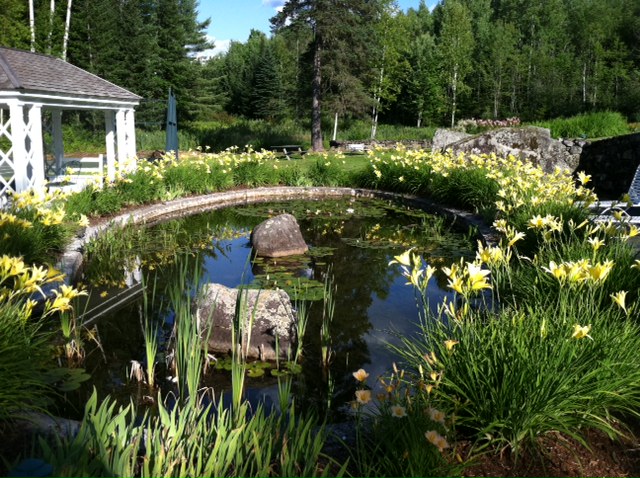
Stone steps lead down the hillside and our garden guests were free to wander about and check out the Rose Garden, the Pond Garden abloom with pink-flowering lily pads and encircled with yellow day lilies, and the Gate Garden.
We have to admit, the Gate Garden is a favorite of ours. This was originally designed as a white garden, but over the decades other plants have been added, and now the palette is muted, rather than white. We like to sit on the stone bench, listen to the water burble in the fountain, and refresh and recharge among the flowers. In bloom on Sunday were several
big plantings of lamb’s ear, covered in bees that seemed deliriously happy to be sipping from the flowers! White astilbe, balloon flower, daisies, peonies and iris flourish here, along with a nice planting of hostas. The big iron gates leading into the garden provide a touch of drama -- and glamour -- to the setting, and are very representative of Dorothy Adair Guider, the property’s original owner, who entertained extensively and counted among her friends the actress Helen Hayes.
Just steps outside the Gate Garden, red bee balm adds a splash of color to the landscape, and helps draw attention to the croquet game set up on the lawn nearby.
A long flower border at the foot of the lawn provides a stopping point for the eye before it travels outward across a bog filled with cattails. We don’t know if any of our guests ventured into the bog across the wooden walkway, but we like to wander in that direction when we’re in need of some wild beauty and hope to see a critter or two.
Although it’s back to our regular schedule today, we are still savoring the memories of last week's garden tour and meeting all of the lovely people who stopped by for a visit at the Adair Country Inn & Restaurant’s gardens.
We were pleased to welcome over 150 gardeners and garden aficionados on Sunday, who strolled the grounds, enjoyed the plantings, and finished up with cool refreshments prepared by head chef Orlo Coots.
This was the 5th Annual WREN Garden Tour, and proceeds are used to support all of the work that WREN does through its programs, the Local Works store, and the art gallery. The tour featured seven outstanding gardens, all unique and beautiful.
Our tour began at Adair’s front garden, an area shaded by two huge maple trees and that features a large selection of hostas, complimented by astilbes, pulmonarias, and day lilies. We find this garden refreshing on a hot summer day, and visitors always appreciate its quiet beauty.
Following the path through the shade garden took our visitors around to the back of the Inn. Guests often enjoy breakfast on the stone patio that is bordered by plantings of phlox, bee balm, Siberian iris and peony. Some of the peonies may even be original to the property, as they sometimes survive 100 years or more. More than one guest on Sunday remarked on the beautiful bronze coleus growing in one of the patio planters; we’ll definitely put this beauty on next year’s must-have list.
Stone steps lead down the hillside and our garden guests were free to wander about and check out the Rose Garden, the Pond Garden abloom with pink-flowering lily pads and encircled with yellow day lilies, and the Gate Garden.
We have to admit, the Gate Garden is a favorite of ours. This was originally designed as a white garden, but over the decades other plants have been added, and now the palette is muted, rather than white. We like to sit on the stone bench, listen to the water burble in the fountain, and refresh and recharge among the flowers. In bloom on Sunday were several
big plantings of lamb’s ear, covered in bees that seemed deliriously happy to be sipping from the flowers! White astilbe, balloon flower, daisies, peonies and iris flourish here, along with a nice planting of hostas. The big iron gates leading into the garden provide a touch of drama -- and glamour -- to the setting, and are very representative of Dorothy Adair Guider, the property’s original owner, who entertained extensively and counted among her friends the actress Helen Hayes.
Just steps outside the Gate Garden, red bee balm adds a splash of color to the landscape, and helps draw attention to the croquet game set up on the lawn nearby.
A long flower border at the foot of the lawn provides a stopping point for the eye before it travels outward across a bog filled with cattails. We don’t know if any of our guests ventured into the bog across the wooden walkway, but we like to wander in that direction when we’re in need of some wild beauty and hope to see a critter or two.
Although it’s back to our regular schedule today, we are still savoring the memories of last week's garden tour and meeting all of the lovely people who stopped by for a visit at the Adair Country Inn & Restaurant’s gardens.
Thursday, July 21, 2011
Spice Up Your Cooking with Herbs!
As the herb garden at my house grows, the aromas fill the air and I start to relate the smells of the herbs to culinary dishes I have used them with — basil, of course, makes me think of pasta tossed with summer tomatoes and pesto. Rubbing the leaves of thyme reminds me of freshly made soup seasoned and finished with chopped thyme. Rosemary brings to mind wonderful roasted new potatoes. Sniffing the cilantro plant immediately makes my mouth water with the thought of freshly made salsa with jalapenos, garden tomatoes and lime.
Throughout history, there have been many different culinary and medical uses of various herbs. Ancient Romans and Greeks crowned their leaders with dill and laurel. The Romans also used dill to purify the air. In the 5th century B.C., Hippocrates, the famous Greek physician, listed approximately 400 herbs in common use. In the Middle Ages, herbs were often used to help preserve meat as well as cover the rotting taste of meals that couldn't be refrigerated. Herbs also helped mask the odors of people who bathed irregularly, if at all. This period was not favorable to the use of herbs in medicine. In fact, the Catholic Church began burning herbalists, having associated them with both witchcraft and paganism.
Herb gardens were almost an essential feature of pioneer homes. They were placed in sunny corners near the house to be readily available to the busy homemaker. As the population of the new country grew, people from many nations brought herbs with them. This resulted in an exchange of slips, seeds, and plants. Many herbs familiar to settlers from other countries were found growing wild in the new country. These included parsley, anise, pennyroyal, sorrel, watercress, liverwort, wild leeks, and lavender. American Indians knew uses for almost every wild, nonpoisonous plant, but they used the plants chiefly for domestic purposes — tanning and dyeing leather and eating.
Today, many herbs are still used both medicinally and for culinary purposes. I will list some of the herbs I use at the Inn. I certainly use some more frequently than others — thyme perhaps being my most favorite. It can be used for almost all types of food, from the lightest broth soup up to hearty beef dishes. While not a hard and fast rule, a basic rule of thumb is to use a softer and more delicate herb with a lighter dish. Chervil, which is very delicate, goes great with light salads, but would be overwhelmed by hearty red meats. Likewise, rosemary, a more substantial herb, can overpower light white fish, but goes very well with crusty roast meats. As always, feel free to experiment, but make sure to start with a small amount of any herb before adding more to suit your taste. Even a light herb like cilantro can overpower and ruin a dish if too much is used. Add fresh herbs only at the end of cooking or upon serving, while it is best to add dried herbs at the beginning and during cooking in order to release their oils and flavors. When cooking and seasoning with herbs, a little can go a long way towards making every bite count.
Arugula: While technically known as a salad green or salad herb, arugula can be added to lettuce, tomatoes and any other mixed baby salad greens to create new and exciting taste sensations. It makes a great pesto herb, though certainly much different than basil. Arugula is very low in calories and is also high in vitamins A and C. Arugula, also known as rocket, is very popular in Italian cuisine. Its leaves have a unique, peppery sweet tang, adding pizzazz even to the blandest salads. Although arugula provides a flavor impact, it does not have a strong aftertaste.
Basil: Sweet basil is one of the most popular culinary herbs. Its flavor is strong enough to hold up to ingredients such as garlic, which make it perfect for pesto. Also indispensable for many Mediterranean dishes, the fresh leaf has a sweet, clove-like spiciness and is excellent with tomato dishes. Basil is considered one of the most important and highly used herbs in the culinary world and is popular in the cooking of many types of cuisine. Especially good in Thai dishes is the Thai Basil whose leaves have a spicy aniseed aroma with hints of mint and citrus. If this is not available, try mixing in a small amount of mint with your basil as a substitute in your Thai dishes.
Bergamot: Although limited in its culinary uses, bergamot imparts a wonderful citrus-like flavor and fragrance that complements fruits and summer beverages and teas. At one time native Americans used it to season and preserve meats. Bergamot oil, which is used in authentic Earl Grey tea, is extracted from this plant.
Chervil: Also known as Gourmet Parsley and Garden Chervil. Chervil is a delicate herb with subtle taste. It has a slightly anise-like flavor that can be quickly lost in cooking. Garnish salads with it, but serve it at the last moment. Chervil is a very popular herb in France. It is one of the classic ingredients in the traditional French herb blend, Fines Herbes and is very popular in French cuisine. It has a delicate flavor and is suitable wherever parsley is used. Chop the leaf into soups (in the last 10 to 12 minutes of cooking so its flavor is not cooked away), omelets, salads, and dressings.
Chives: Chives are a mild member herb of the onion family. Chives have many uses and can be added to potato salad, baked potatoes, soups, salads, omelets, dips and spreads, pastas and sauces. Use it anywhere you want to add onion flavor without the harsh pungency of onion. Add fresh at the end of cooking to preserve the flavor. The flavor is so brilliant that you will probably want a fresh pot of chives on your windowsill, even if you have nothing else in your herb garden. Store fresh chives in damp paper towels in an airtight container in the refrigerator. You can also chop fresh chives and freeze them with water in ice cube trays to use later when needed.
Cilantro: This is one of the first “exotic” herbs I used after graduating from culinary school in the mid ‘80’s. Back then, the most common herbs were the classic French and Italian herbs. Many herbs from other cuisines just were not popular yet in American cooking. Cilantro is also known as Chinese parsley. Cilantro is used in many cuisines around the world. Most notably it is used to enliven Mexican and South American food as well as Thai and Vietnamese. This is a multi-ethnic herb that is used in everything from delicate Asian spring rolls to substantial Mexican dishes. Cilantro is the leafy part of the coriander plant. Its unique flavor is quite distinctive and can liven up even a simple chicken broth. Cilantro has a faint overtone of anise and a somewhat delicate peppery taste. Use cilantro in tacos, salsas, soups, stews, chicken and rice, salads, tomato-based sauces and as a garnish. Use sparingly, though as it can very easily overwhelm your food.
Dill: Dill is available as both fresh weed and seed, both fresh and dried. Fresh leaves can be kept in a plastic bag in the refrigerator or chop finely and mix with one tablespoon of water and freeze in ice cube trays. Dill or dill weed is an herb that produces clusters of small flowers from which dill seed is gathered and dill weed is obtained from the thin, feathery leaves. The light aroma of dill faintly resembles licorice. Dill weed is good in soups, omelets, seafood dishes, herring, salmon, potato salads, and steamed vegetables. Dill seed is used in breads, pickling, cabbage dishes, stews, rice and cooked root vegetables. Dill has a totally unique spicy green taste. Add whole seeds to potato salad, pickles, bean soups and salmon dishes. Ground seed can flavor herb butter, mayonnaise and mustard. The leaves go well with fish, cream cheese and cucumber.
Juniper Berry: The juniper berry is the female seed cone produced by the various species of junipers that are herbal trees. It is not a true berry but a cone with unusually fleshy and merged scales, which give it a berry-like appearance. Not all species of juniper berries are edible. Some are toxic and consumption is inadvisable. The mature, dark berries are usually, but not exclusively, used in cuisine, while gin is flavored with fully-grown but immature green berries. The crushed berries of the juniper tree have an aromatic, resinous flavor often featured in pâtés, marinades and stuffing for pork, venison and other wild game. They are also a popular flavoring for sauerkraut, sauces, ham and cabbage. They are also used with root vegetables, legumes and bean dishes.
Lemon Balm: Lemon balm is a lemon-scented herb of the mint family. For a zesty, flavorful general seasoning, use it paired with tarragon. Adding some freshly minced leaves to lamb or fish marinades for the grill will add a wonderful layer of flavor. The taste of the leaves adds the perfect tangy note to fruit salads. Freshly steamed vegetables come alive when tossed with a chiffonade of Lemon Balm and a touch of cracked pepper. When using whole leaves be sure to handle with care, as they tend to bruise and turn black. Mix lemon balm with other fresh herbs for homemade herb vinegar. Freeze some leaves in ice cubes to serve in lemonade. This is a great herb for growing in window boxes. It does well indoors in a sunny window. The citrus aroma can help keep mosquitoes away as well.
Lemon Verbena: If you like lemon, this is the herb for you! It has a very lemony taste without any bitterness. Originating in Central and South America, this herb was carried home by Spanish explorers in the 17th century. Its popularity quickly spread throughout Europe. When sprinkled over salads and vegetables, it adds a wonderful lemony flavor. Use this to create flavor in stuffing for meat or poultry. Lemon Verbena is a great herb to use liberally when on a low salt diet due to its intense flavor. Also try combining lemon verbena with dried celery, ground peppercorns, lovage leaves or any mix of herbs and spices that taste well with lemon as a mild seasoning mixture.
Lovage: Lovage is also known as love parsley, sea parsley and smallage. The grated fresh root can be cooked as a vegetable or used raw in salads. Lovage is a hardy perennial herb, with ribbed stalks similar to celery with hollow stems that divide into branches near the top. It has yellow flowers and it leaves are dark green. Roots have a nutty favor. Lovage has a strong taste and aroma similar to celery and parsley
Marjoram: Marjoram is an herb that has a mild, sweet flavor similar to oregano (it is closely related and of the same family — Origanum) with perhaps a hint of balsam. It is said to be “the meat herb" but it compliments all savory foods. While fresh marjoram is excellent with salads and mild flavored foods, it has the best taste and greatest pungency when dried. Marjoram has a slightly more delicate flavor than Oregano. Because it is more delicate, marjoram should be added toward the end of cooking so its flavor is not lost. Marjoram goes well with pork and veal and compliments stuffing for poultry, dumplings and herb scones or breads.
Mustard: Mustard has been known since prehistoric times and has many culinary uses. The Romans named this herb from mustus (the new wine they mixed with the seed) and ardens (for fiery). The hot little black and brown mustard seeds are ground and mixed with water, vinegar or other liquids, and turned into a condiment also known as mustard. The seeds are also pressed to make mustard oil, and the edible leaves can be eaten as mustard greens. White mustard seeds are used in pickles as a strong preservative and in mayonnaise as an emulsifier. The yellow, four petal blooms of the plant that flower in mid-summer are also edible and contain a mild mustard flavor. They can be sprinkled on sandwiches or tossed on salads.
Mint: One of the most versatile herbs, thought mostly thought of as a sweet herb. Mint is an herb that comes in many varieties such as peppermint, spearmint, apple mint, lemon mint and even chocolate mint. Mint came to the New World with colonists, who used it in tea for medicinal purposes. Mint is used for seasoning lamb, vegetable such as carrots, bell pepper, and tomatoes, in yogurt dressings, and breads. It is also used in the Middle East for salads, tabouli and marinated vegetables. Mint is good in soups, salads, sauces, plain meat, fish and poultry, stews, sweet or savory recipes, extremely good with chocolate- or lemon-based desserts. Add near the end of cooking for a better flavor.
Oregano: Oregano is an herb that derives its name from two Greek words meaning "the joy of the mountain." It is a hardy member of the mint family that has been used for flavoring fish, meat and sauces since ancient times. Oregano goes well with vegetables, roast beef, lamb, chicken and pork. Generally used to season Mexican, Italian, Greek and Spanish dishes, oregano has a warm, aromatic scent and robust taste.
Parsley: Also known as curly parsley, flat leaf parsley and Italian parsley. Parsley is a great all around herb. It quickly adds a touch of color and texture to any recipe. The aroma and taste of parsley is very distinctive, which is in contrast to its reputation as being bland and only used as a garnish. Especially good in omelets, scrambled eggs, mashed potatoes, soups, pasta and vegetable dishes, parsley also works nicely in sauces for fish, poultry, veal and pork. Use fresh leaves as garnish. Parsley has a delicate favor that combines well with other herbs like basil, bay leaves, chives, dill weed, garlic, marjoram, mint, oregano and thyme. Flat leaf or Italian is used primarily in cooking because of its more robust flavor, which should be added at the end of cooking for better flavor.
Rosemary: Rosemary is an herb of the mint family. It is a small evergreen shrub that is native to the Mediterranean and likes warm climates, but will flourish in nearly any climate. It is grown all over the world. It makes a great addition to window boxes and is a nice natural mosquito repellent. Rosemary's aromatic flavor blends well with garlic and thyme to season lamb roasts, meat stews, and marinades. When used sparingly, rosemary also enlivens lighter fish and poultry dishes, tomato sauces, and vegetables. Some nice uses include dressing fresh steamed red potatoes and peas or a stir-fried mixture of zucchini and summer squash. Rosemary has a tea-like aroma and a piney flavor. Crush leaves by hand or with a mortar and pestle before using.
Sage: One of my favorite herbs is sage. It must be used carefully though as it easily can overpower a dish. Sage is an herb from an evergreen shrub in the mint family. Fresh sage sprigs have long, narrow grayish green leaves and, although it is a member of the mint family, it has a musty yet smoky aroma. Sage enhances pork, lamb, meats, and sausages. Chopped leaves flavor salads, pickles, and cheese. Crumble leaves for full fragrance. If using dried, ground sage, use sparingly as foods absorb its flavor more quickly.
Savory: There are two types of savory — winter and summer. The two look much the same, but winter is a bit more pungent. Savory smells and tastes like mint and rosemary chopped together. Savory is nicknamed the bean herb. It is typically used in soups, beans and as a meat and poultry seasoning. This herb tastes slightly warm and sharp. It is a very strong herb and should be used sparingly. Use summer savory, with its more delicate flavor, for tender baby green beans, and winter savory to enhance a whole medley of dried beans and lentils.
Tarragon: This is one herb that took me a while to enjoy. It was overused at some of the first places I worked and it has taken me years to appreciate its qualities. Tarragon is an exceptional herb. It has a subtle and sophisticated flavor and is an essential herb in French cuisine. Its flavor is delicate and almost licorice- or anise-like. Tarragon, together with parsley, chervil, and chives make a traditional French blend, Fines Herbes. Tarragon is exceptional in egg dishes, poached fish, mushrooms and other vegetables, as well as with chicken and in salad dressings. It is the main flavoring in sauce béarnaise. Tarragon is also used to infuse vinegar and olive oils.
Thyme: This is my absolute favorite herb due to it fragrance, taste and versatility. There is just something magical for me when I chop fresh thyme. It brings back memories of new and exciting foods from my early culinary jobs. Fresh garden thyme is an herb that has thin grayish green leaves and a subtle lemon, yet minty aroma and taste. Thyme is used in a wide variety of cuisine, but is most closely associated with French cuisine. It is often used in soups and sauces, with meat, poultry or fish. It is also a very important component of herbes de Provence and bouquet garni. Thyme is included in seasoning blends for poultry and stuffing and also commonly used in fish sauces, chowders, and soups. It goes well with lamb and veal as well as in eggs and croquettes. Thyme is also often paired with vegetables such as tomatoes as it brings out the fresh garden flavors of these foods.
Garden Fresh Basil Pesto
Makes 1 cup
2 cups fresh basil leaves, packed
1/2 cup freshly grated Parmesan cheese
1/2 cup extra virgin olive oil
1/2 cup pine nuts (can substitute walnuts)
3 medium-sized garlic cloves
salt and freshly ground black pepper to taste
Combine basil, pine nuts and garlic in food processor; pulse a few times. Slowly add oil in slow steady stream. Scrape down sides; add salt and pepper. Add cheese and process to desired consistency. Store covered in fridge. Push plastic wrap tight against pesto to keep from turning brown. A little fresh lemon juice will also help to prevent browning.
— Orlo Coots is Head Chef at Adair Country Inn & Restaurant. Enjoy his cooking featuring local produce, cheeses and meats Thursdays through Mondays by making a reservation at 603-444-2600. Orlo can be reached at cheforlo@hotmail.com for questions about this recipe or any other food-related questions. Remember — whether cooking for one or for a crowd, make every bite count.
Throughout history, there have been many different culinary and medical uses of various herbs. Ancient Romans and Greeks crowned their leaders with dill and laurel. The Romans also used dill to purify the air. In the 5th century B.C., Hippocrates, the famous Greek physician, listed approximately 400 herbs in common use. In the Middle Ages, herbs were often used to help preserve meat as well as cover the rotting taste of meals that couldn't be refrigerated. Herbs also helped mask the odors of people who bathed irregularly, if at all. This period was not favorable to the use of herbs in medicine. In fact, the Catholic Church began burning herbalists, having associated them with both witchcraft and paganism.
Herb gardens were almost an essential feature of pioneer homes. They were placed in sunny corners near the house to be readily available to the busy homemaker. As the population of the new country grew, people from many nations brought herbs with them. This resulted in an exchange of slips, seeds, and plants. Many herbs familiar to settlers from other countries were found growing wild in the new country. These included parsley, anise, pennyroyal, sorrel, watercress, liverwort, wild leeks, and lavender. American Indians knew uses for almost every wild, nonpoisonous plant, but they used the plants chiefly for domestic purposes — tanning and dyeing leather and eating.
Today, many herbs are still used both medicinally and for culinary purposes. I will list some of the herbs I use at the Inn. I certainly use some more frequently than others — thyme perhaps being my most favorite. It can be used for almost all types of food, from the lightest broth soup up to hearty beef dishes. While not a hard and fast rule, a basic rule of thumb is to use a softer and more delicate herb with a lighter dish. Chervil, which is very delicate, goes great with light salads, but would be overwhelmed by hearty red meats. Likewise, rosemary, a more substantial herb, can overpower light white fish, but goes very well with crusty roast meats. As always, feel free to experiment, but make sure to start with a small amount of any herb before adding more to suit your taste. Even a light herb like cilantro can overpower and ruin a dish if too much is used. Add fresh herbs only at the end of cooking or upon serving, while it is best to add dried herbs at the beginning and during cooking in order to release their oils and flavors. When cooking and seasoning with herbs, a little can go a long way towards making every bite count.
Arugula: While technically known as a salad green or salad herb, arugula can be added to lettuce, tomatoes and any other mixed baby salad greens to create new and exciting taste sensations. It makes a great pesto herb, though certainly much different than basil. Arugula is very low in calories and is also high in vitamins A and C. Arugula, also known as rocket, is very popular in Italian cuisine. Its leaves have a unique, peppery sweet tang, adding pizzazz even to the blandest salads. Although arugula provides a flavor impact, it does not have a strong aftertaste.
Basil: Sweet basil is one of the most popular culinary herbs. Its flavor is strong enough to hold up to ingredients such as garlic, which make it perfect for pesto. Also indispensable for many Mediterranean dishes, the fresh leaf has a sweet, clove-like spiciness and is excellent with tomato dishes. Basil is considered one of the most important and highly used herbs in the culinary world and is popular in the cooking of many types of cuisine. Especially good in Thai dishes is the Thai Basil whose leaves have a spicy aniseed aroma with hints of mint and citrus. If this is not available, try mixing in a small amount of mint with your basil as a substitute in your Thai dishes.
Bergamot: Although limited in its culinary uses, bergamot imparts a wonderful citrus-like flavor and fragrance that complements fruits and summer beverages and teas. At one time native Americans used it to season and preserve meats. Bergamot oil, which is used in authentic Earl Grey tea, is extracted from this plant.
Chervil: Also known as Gourmet Parsley and Garden Chervil. Chervil is a delicate herb with subtle taste. It has a slightly anise-like flavor that can be quickly lost in cooking. Garnish salads with it, but serve it at the last moment. Chervil is a very popular herb in France. It is one of the classic ingredients in the traditional French herb blend, Fines Herbes and is very popular in French cuisine. It has a delicate flavor and is suitable wherever parsley is used. Chop the leaf into soups (in the last 10 to 12 minutes of cooking so its flavor is not cooked away), omelets, salads, and dressings.
Chives: Chives are a mild member herb of the onion family. Chives have many uses and can be added to potato salad, baked potatoes, soups, salads, omelets, dips and spreads, pastas and sauces. Use it anywhere you want to add onion flavor without the harsh pungency of onion. Add fresh at the end of cooking to preserve the flavor. The flavor is so brilliant that you will probably want a fresh pot of chives on your windowsill, even if you have nothing else in your herb garden. Store fresh chives in damp paper towels in an airtight container in the refrigerator. You can also chop fresh chives and freeze them with water in ice cube trays to use later when needed.
Cilantro: This is one of the first “exotic” herbs I used after graduating from culinary school in the mid ‘80’s. Back then, the most common herbs were the classic French and Italian herbs. Many herbs from other cuisines just were not popular yet in American cooking. Cilantro is also known as Chinese parsley. Cilantro is used in many cuisines around the world. Most notably it is used to enliven Mexican and South American food as well as Thai and Vietnamese. This is a multi-ethnic herb that is used in everything from delicate Asian spring rolls to substantial Mexican dishes. Cilantro is the leafy part of the coriander plant. Its unique flavor is quite distinctive and can liven up even a simple chicken broth. Cilantro has a faint overtone of anise and a somewhat delicate peppery taste. Use cilantro in tacos, salsas, soups, stews, chicken and rice, salads, tomato-based sauces and as a garnish. Use sparingly, though as it can very easily overwhelm your food.
Dill: Dill is available as both fresh weed and seed, both fresh and dried. Fresh leaves can be kept in a plastic bag in the refrigerator or chop finely and mix with one tablespoon of water and freeze in ice cube trays. Dill or dill weed is an herb that produces clusters of small flowers from which dill seed is gathered and dill weed is obtained from the thin, feathery leaves. The light aroma of dill faintly resembles licorice. Dill weed is good in soups, omelets, seafood dishes, herring, salmon, potato salads, and steamed vegetables. Dill seed is used in breads, pickling, cabbage dishes, stews, rice and cooked root vegetables. Dill has a totally unique spicy green taste. Add whole seeds to potato salad, pickles, bean soups and salmon dishes. Ground seed can flavor herb butter, mayonnaise and mustard. The leaves go well with fish, cream cheese and cucumber.
Juniper Berry: The juniper berry is the female seed cone produced by the various species of junipers that are herbal trees. It is not a true berry but a cone with unusually fleshy and merged scales, which give it a berry-like appearance. Not all species of juniper berries are edible. Some are toxic and consumption is inadvisable. The mature, dark berries are usually, but not exclusively, used in cuisine, while gin is flavored with fully-grown but immature green berries. The crushed berries of the juniper tree have an aromatic, resinous flavor often featured in pâtés, marinades and stuffing for pork, venison and other wild game. They are also a popular flavoring for sauerkraut, sauces, ham and cabbage. They are also used with root vegetables, legumes and bean dishes.
Lemon Balm: Lemon balm is a lemon-scented herb of the mint family. For a zesty, flavorful general seasoning, use it paired with tarragon. Adding some freshly minced leaves to lamb or fish marinades for the grill will add a wonderful layer of flavor. The taste of the leaves adds the perfect tangy note to fruit salads. Freshly steamed vegetables come alive when tossed with a chiffonade of Lemon Balm and a touch of cracked pepper. When using whole leaves be sure to handle with care, as they tend to bruise and turn black. Mix lemon balm with other fresh herbs for homemade herb vinegar. Freeze some leaves in ice cubes to serve in lemonade. This is a great herb for growing in window boxes. It does well indoors in a sunny window. The citrus aroma can help keep mosquitoes away as well.
Lemon Verbena: If you like lemon, this is the herb for you! It has a very lemony taste without any bitterness. Originating in Central and South America, this herb was carried home by Spanish explorers in the 17th century. Its popularity quickly spread throughout Europe. When sprinkled over salads and vegetables, it adds a wonderful lemony flavor. Use this to create flavor in stuffing for meat or poultry. Lemon Verbena is a great herb to use liberally when on a low salt diet due to its intense flavor. Also try combining lemon verbena with dried celery, ground peppercorns, lovage leaves or any mix of herbs and spices that taste well with lemon as a mild seasoning mixture.
Lovage: Lovage is also known as love parsley, sea parsley and smallage. The grated fresh root can be cooked as a vegetable or used raw in salads. Lovage is a hardy perennial herb, with ribbed stalks similar to celery with hollow stems that divide into branches near the top. It has yellow flowers and it leaves are dark green. Roots have a nutty favor. Lovage has a strong taste and aroma similar to celery and parsley
Marjoram: Marjoram is an herb that has a mild, sweet flavor similar to oregano (it is closely related and of the same family — Origanum) with perhaps a hint of balsam. It is said to be “the meat herb" but it compliments all savory foods. While fresh marjoram is excellent with salads and mild flavored foods, it has the best taste and greatest pungency when dried. Marjoram has a slightly more delicate flavor than Oregano. Because it is more delicate, marjoram should be added toward the end of cooking so its flavor is not lost. Marjoram goes well with pork and veal and compliments stuffing for poultry, dumplings and herb scones or breads.
Mustard: Mustard has been known since prehistoric times and has many culinary uses. The Romans named this herb from mustus (the new wine they mixed with the seed) and ardens (for fiery). The hot little black and brown mustard seeds are ground and mixed with water, vinegar or other liquids, and turned into a condiment also known as mustard. The seeds are also pressed to make mustard oil, and the edible leaves can be eaten as mustard greens. White mustard seeds are used in pickles as a strong preservative and in mayonnaise as an emulsifier. The yellow, four petal blooms of the plant that flower in mid-summer are also edible and contain a mild mustard flavor. They can be sprinkled on sandwiches or tossed on salads.
Mint: One of the most versatile herbs, thought mostly thought of as a sweet herb. Mint is an herb that comes in many varieties such as peppermint, spearmint, apple mint, lemon mint and even chocolate mint. Mint came to the New World with colonists, who used it in tea for medicinal purposes. Mint is used for seasoning lamb, vegetable such as carrots, bell pepper, and tomatoes, in yogurt dressings, and breads. It is also used in the Middle East for salads, tabouli and marinated vegetables. Mint is good in soups, salads, sauces, plain meat, fish and poultry, stews, sweet or savory recipes, extremely good with chocolate- or lemon-based desserts. Add near the end of cooking for a better flavor.
Oregano: Oregano is an herb that derives its name from two Greek words meaning "the joy of the mountain." It is a hardy member of the mint family that has been used for flavoring fish, meat and sauces since ancient times. Oregano goes well with vegetables, roast beef, lamb, chicken and pork. Generally used to season Mexican, Italian, Greek and Spanish dishes, oregano has a warm, aromatic scent and robust taste.
Parsley: Also known as curly parsley, flat leaf parsley and Italian parsley. Parsley is a great all around herb. It quickly adds a touch of color and texture to any recipe. The aroma and taste of parsley is very distinctive, which is in contrast to its reputation as being bland and only used as a garnish. Especially good in omelets, scrambled eggs, mashed potatoes, soups, pasta and vegetable dishes, parsley also works nicely in sauces for fish, poultry, veal and pork. Use fresh leaves as garnish. Parsley has a delicate favor that combines well with other herbs like basil, bay leaves, chives, dill weed, garlic, marjoram, mint, oregano and thyme. Flat leaf or Italian is used primarily in cooking because of its more robust flavor, which should be added at the end of cooking for better flavor.
Rosemary: Rosemary is an herb of the mint family. It is a small evergreen shrub that is native to the Mediterranean and likes warm climates, but will flourish in nearly any climate. It is grown all over the world. It makes a great addition to window boxes and is a nice natural mosquito repellent. Rosemary's aromatic flavor blends well with garlic and thyme to season lamb roasts, meat stews, and marinades. When used sparingly, rosemary also enlivens lighter fish and poultry dishes, tomato sauces, and vegetables. Some nice uses include dressing fresh steamed red potatoes and peas or a stir-fried mixture of zucchini and summer squash. Rosemary has a tea-like aroma and a piney flavor. Crush leaves by hand or with a mortar and pestle before using.
Sage: One of my favorite herbs is sage. It must be used carefully though as it easily can overpower a dish. Sage is an herb from an evergreen shrub in the mint family. Fresh sage sprigs have long, narrow grayish green leaves and, although it is a member of the mint family, it has a musty yet smoky aroma. Sage enhances pork, lamb, meats, and sausages. Chopped leaves flavor salads, pickles, and cheese. Crumble leaves for full fragrance. If using dried, ground sage, use sparingly as foods absorb its flavor more quickly.
Savory: There are two types of savory — winter and summer. The two look much the same, but winter is a bit more pungent. Savory smells and tastes like mint and rosemary chopped together. Savory is nicknamed the bean herb. It is typically used in soups, beans and as a meat and poultry seasoning. This herb tastes slightly warm and sharp. It is a very strong herb and should be used sparingly. Use summer savory, with its more delicate flavor, for tender baby green beans, and winter savory to enhance a whole medley of dried beans and lentils.
Tarragon: This is one herb that took me a while to enjoy. It was overused at some of the first places I worked and it has taken me years to appreciate its qualities. Tarragon is an exceptional herb. It has a subtle and sophisticated flavor and is an essential herb in French cuisine. Its flavor is delicate and almost licorice- or anise-like. Tarragon, together with parsley, chervil, and chives make a traditional French blend, Fines Herbes. Tarragon is exceptional in egg dishes, poached fish, mushrooms and other vegetables, as well as with chicken and in salad dressings. It is the main flavoring in sauce béarnaise. Tarragon is also used to infuse vinegar and olive oils.
Thyme: This is my absolute favorite herb due to it fragrance, taste and versatility. There is just something magical for me when I chop fresh thyme. It brings back memories of new and exciting foods from my early culinary jobs. Fresh garden thyme is an herb that has thin grayish green leaves and a subtle lemon, yet minty aroma and taste. Thyme is used in a wide variety of cuisine, but is most closely associated with French cuisine. It is often used in soups and sauces, with meat, poultry or fish. It is also a very important component of herbes de Provence and bouquet garni. Thyme is included in seasoning blends for poultry and stuffing and also commonly used in fish sauces, chowders, and soups. It goes well with lamb and veal as well as in eggs and croquettes. Thyme is also often paired with vegetables such as tomatoes as it brings out the fresh garden flavors of these foods.
Garden Fresh Basil Pesto
Makes 1 cup
2 cups fresh basil leaves, packed
1/2 cup freshly grated Parmesan cheese
1/2 cup extra virgin olive oil
1/2 cup pine nuts (can substitute walnuts)
3 medium-sized garlic cloves
salt and freshly ground black pepper to taste
Combine basil, pine nuts and garlic in food processor; pulse a few times. Slowly add oil in slow steady stream. Scrape down sides; add salt and pepper. Add cheese and process to desired consistency. Store covered in fridge. Push plastic wrap tight against pesto to keep from turning brown. A little fresh lemon juice will also help to prevent browning.
— Orlo Coots is Head Chef at Adair Country Inn & Restaurant. Enjoy his cooking featuring local produce, cheeses and meats Thursdays through Mondays by making a reservation at 603-444-2600. Orlo can be reached at cheforlo@hotmail.com for questions about this recipe or any other food-related questions. Remember — whether cooking for one or for a crowd, make every bite count.
Thursday, June 9, 2011
‘Swing & Sweets’ is a Real Treat!
We can’t wait for the evening of Tuesday, June 14, to break out our dancing shoes for an evening of “Swing & Sweets,” a perfect blend of desserts and dancing to the sound of Swing North Big Band. We invite you to join us at the lovely Sugar Hill Meeting House from 7:30- 9 p.m. for a delightful evening of dancing and sweet confections.
The great music, dance and delicious desserts represent another aspect of our fabulous Fields of Lupine Festival that takes place all around the Franconia Notch region, with dozens of different events in Lincoln, Sugar Hill, Franconia, Easton, and Bethlehem. The Adair Country Inn & Restaurant is among the restaurants and inns that will present a selection of fine desserts during the evening to enhance your enjoyment of the wonderful music that the popular Swing North Big Band is providing during this “Open Rehearsal” concert.
Adair’s Chef Orlo will prepare a gorgeous Lemon Angel Food Chiffon Cake, topped with berries and homemade oreos. This light and airy dessert is one of our favorites and we can’t wait for you to try it, too!
Other desserts on the menu include a Vanilla Sponge Cake with lemon cream and chocolate mousse filling, Chocolate Ganache Cake, Chocolate Eclairs, and a Graham Cracker-Crusted Cheese Cake with fresh strawberries and cream, all compliments of the Café Lafayette Dinner Train; Strawberry Vacherin and Cocoa Nib Sliders provided by the Mountain Club on Loon; and an old favorite, Aunt Anne’s Blueberry Cake from the Franconia Heritage Museum.
Harman’s Cheese & Country Store will offer assorted cheese and crackers, as a delicious side note to all the sweets. Polly’s Pancake Parlor, Sunset Hill House, and Indian Head Resort are also contributing goodies for the evening. We won’t reveal what their chefs are concocting, but we promise it’ll be worth coming out for.
So, dust off your dancing shoes, grab your partner and join us for a wonderful evening of Swing-era music. Don’t care to dance? Come and listen and enjoy dessert while the 18-piece “Basie-style” band belts out some tunes. Their arrangements include everything from Count Basie and Glen Miller to Maynard Ferguson and Sammy Nestico.
Admission to “Swing & Sweets” is $10 per person or $18 per couple, paid at the door. Call us at Adair at (603) 444-2600 if you have any questions, or learn more about Festival events at www.franconianotch.org/special-events/.
The great music, dance and delicious desserts represent another aspect of our fabulous Fields of Lupine Festival that takes place all around the Franconia Notch region, with dozens of different events in Lincoln, Sugar Hill, Franconia, Easton, and Bethlehem. The Adair Country Inn & Restaurant is among the restaurants and inns that will present a selection of fine desserts during the evening to enhance your enjoyment of the wonderful music that the popular Swing North Big Band is providing during this “Open Rehearsal” concert.
Adair’s Chef Orlo will prepare a gorgeous Lemon Angel Food Chiffon Cake, topped with berries and homemade oreos. This light and airy dessert is one of our favorites and we can’t wait for you to try it, too!
Other desserts on the menu include a Vanilla Sponge Cake with lemon cream and chocolate mousse filling, Chocolate Ganache Cake, Chocolate Eclairs, and a Graham Cracker-Crusted Cheese Cake with fresh strawberries and cream, all compliments of the Café Lafayette Dinner Train; Strawberry Vacherin and Cocoa Nib Sliders provided by the Mountain Club on Loon; and an old favorite, Aunt Anne’s Blueberry Cake from the Franconia Heritage Museum.
Harman’s Cheese & Country Store will offer assorted cheese and crackers, as a delicious side note to all the sweets. Polly’s Pancake Parlor, Sunset Hill House, and Indian Head Resort are also contributing goodies for the evening. We won’t reveal what their chefs are concocting, but we promise it’ll be worth coming out for.
So, dust off your dancing shoes, grab your partner and join us for a wonderful evening of Swing-era music. Don’t care to dance? Come and listen and enjoy dessert while the 18-piece “Basie-style” band belts out some tunes. Their arrangements include everything from Count Basie and Glen Miller to Maynard Ferguson and Sammy Nestico.
Admission to “Swing & Sweets” is $10 per person or $18 per couple, paid at the door. Call us at Adair at (603) 444-2600 if you have any questions, or learn more about Festival events at www.franconianotch.org/special-events/.
Wednesday, June 8, 2011
Meet the Author -- Bethlehem Plays a Part in Her Newest Novel
Curling up with a good book and a cup of tea is one of life’s simple and satisfying pleasures. Even better is being able to meet the author of a “really good read.” At Adair Country Inn & Restaurant, we wanted to give our Lupine Festival visitors, guests, and local residents the opportunity to meet author Lois Mathieu, who set part of her new novel in Bethlehem. She’ll be at the Inn at 4 p.m. on Saturday, June 18, for a Tea & Book Signing, and we’d love to have you join us for refreshments and conversation.
Lois has just penned her latest book, “Debut,” the story of a mother and child whose bond is broken when the mother gives her child up for adoption. The two live much of their lives secretly yearning for each other. More than 20 years pass before they meet and come to realize how deeply they have both suffered from their irrevocable loss.
As in any good book, the plot reveals the challenges and obstacles the characters must confront: the birth mom, a New Hampshire girl bound for college, who gives up her first born, and goes on to marry and have three more children, but remains burdened by sorrow and guilt for giving up her first child; the adoptive parents who assume that unconditional love for their daughter is sufficient to keep her from opening the door to the past; and the adoptive child, who wonders about her biological heritage when her extraordinary singing voice becomes evident. The novel opens when she is preparing for her debut at the Metropolitan Opera House and is also hoping to receive a reply letter from her birth mother, after having contacted the adoption agency.
We’re intrigued that Lois chose Bethlehem as the home of the birth mother. “I chose it for two reasons,” she says. “The name evokes the feeling that something special will take place, and I wanted the birth mother character to live in a White Mountains town, in a rural community that would rub against the sophisticated lifestyle of Manhattan and Westchester County. I had a feel for the rural northern New Hampshire setting because my husband and I had hiked in the White Mountains on numerous occasions many summers ago. I was not familiar with Bethlehem, but when I discovered its remarkable history I felt that Bethlehem had chosen “Debut.”
Mathieu holds a B.A. degree from Syracuse University in New York and a Master's of English at Trinity College in Connecticut. She is also the author of the novel “Quiet but Dangerous,” and her poetry has been published in a variety of literary journals.
Join us at the Adair Country Inn & Restaurant on June 18 at 4 p.m., and enjoy a cup of tea and chat with Lois. She’ll be happy to answer your questions about the book and her writing process. It’s a great opportunity to have a face-to-face conversation with an author. Copies of her novel will be available for purchase and Lois will inscribe a personal message for you, if you’d like. For more information contact the innkeepers at (603)444-2600
Saturday, June 4, 2011
Local Food: Know your farmer, know your food
As I started to write about the Local Food Movement, I was struck by the fact that eating local food should not be a movement, but rather just be the way everyone eats. Food is grown here and eaten here — what could be simpler? It was certainly the way our grandparents and their parents ate. When and why did it become easier to have our foods shipped from hundreds — if not thousands — of miles away? However, this is where we are. Getting foods which are grown and delivered locally, while easier than in recent years, is still harder than getting foods grown from the other side of the country.
Eating local has many more benefits than eating foods produced and shipped from other parts of the country.
• Eating local keeps more money in the local economy. You are giving your money to a local farmer, who, in turn, will spend his or her money locally.
• Locally grown produce is fresher. Food sold to large supermarkets has been picked, stored, shipped and stored again for days, if not weeks. Local food purchased at a farmers market or small independent grocer has often been picked within 24 hours of your purchase.
• The freshness also increases the flavor and the health benefits of the produce. Once picked, the flavor and nutritional value start to decline. A perfect example is the tomato. Eat a local tomato picked and sold within 24 hours and compare that to a tomato purchased at a large supermarket. That tomato was probably picked green and left to “ripen” inside a cardboard box for several days while being shipped across the country. After eating a locally grown tomato you will have a hard time eating a regular supermarket tomato again.
• Eating local food also leads to more variety. A small farmer can grow small crops that would probably never sell in large supermarkets. Larger farms do not have that opportunity as they have demands for large volumes of produce which makes variety more difficult. Local farmers plant what's delicious, healthful and in local demand.
• Eating local also cuts down on pollution and leads to better air quality. Less driving to ship the product and generally less harsh farming practices make local farming greener than large-scale farms. The average supermarket potato travels over 1,000 miles from farm to market. That requires many gallons of fuel and produces many pounds of pollution. Local food reduces or eliminates the costs, both monetary and planetary, of transportation, processing, packaging, and advertising.
While one downside of eating local can be the perceived higher cost of locally grown food, that really is not the case. While the dollar price paid may generally be higher, because the food is fresher it will last longer, giving you more time to eat it instead of throwing it away. Also, because it tastes better, you will be more apt to want to eat it, instead of looking at it and not be excited about eating it. Isn’t an apple you picked yourself more enticing than one taken out of a plastic bag? Another cost saving of eating local is the health benefit. If the food you eat is healthier, you will be healthier, spending less on medicines and prescriptions. Think of it as an extra health insurance policy.
Local food combines production, processing, distribution and consumption on a small scale, which helps to sustain local economies and a strong connection between farm and table. While local may be your neighbor or a farm within day’s drive, buying local ensures that you will often be buying the food from the person who grew it.
Some ways to eat locally include:
— shop weekly at your local farmers market or farm stand
— join a CSA (Community Supported Agriculture) and get weekly deliveries of the season's harvest
— buy from local grocers and co-ops committed to stocking local food
— support restaurants and food vendors that buy locally produced food
— visit local farmers and "u-picks"
— ask your grocer or favorite restaurant what local foods they carry
Native Tomato and Local Goat Cheese Salad
1 Large farm-ripened tomato
2-3 Tablespoons of your favorite local goat cheese
Garden fresh herbs
Balsamic vinegar
Extra virgin olive oil
Salt and freshly ground black pepper
Slice tomato into thick rounds, layer on plate.
Crumble goat cheese onto slices.
Drizzle with vinegar and oil.
Sprinkle with salt and pepper.
Enjoy the fresh flavors of summer with farm fresh foods.
— Orlo Coots is Head Chef at Adair Country Inn & Restaurant. Enjoy his cooking featuring local produce, cheeses and meats Thursdays through Mondays by making a reservation at 603-444-2600. Orlo can be reached at cheforlo@hotmail.com for questions about this recipe or any other food-related questions. Remember — whether cooking for one or for a crowd, make every bite count.
Eating local has many more benefits than eating foods produced and shipped from other parts of the country.
• Eating local keeps more money in the local economy. You are giving your money to a local farmer, who, in turn, will spend his or her money locally.
• Locally grown produce is fresher. Food sold to large supermarkets has been picked, stored, shipped and stored again for days, if not weeks. Local food purchased at a farmers market or small independent grocer has often been picked within 24 hours of your purchase.
• The freshness also increases the flavor and the health benefits of the produce. Once picked, the flavor and nutritional value start to decline. A perfect example is the tomato. Eat a local tomato picked and sold within 24 hours and compare that to a tomato purchased at a large supermarket. That tomato was probably picked green and left to “ripen” inside a cardboard box for several days while being shipped across the country. After eating a locally grown tomato you will have a hard time eating a regular supermarket tomato again.
• Eating local food also leads to more variety. A small farmer can grow small crops that would probably never sell in large supermarkets. Larger farms do not have that opportunity as they have demands for large volumes of produce which makes variety more difficult. Local farmers plant what's delicious, healthful and in local demand.
• Eating local also cuts down on pollution and leads to better air quality. Less driving to ship the product and generally less harsh farming practices make local farming greener than large-scale farms. The average supermarket potato travels over 1,000 miles from farm to market. That requires many gallons of fuel and produces many pounds of pollution. Local food reduces or eliminates the costs, both monetary and planetary, of transportation, processing, packaging, and advertising.
While one downside of eating local can be the perceived higher cost of locally grown food, that really is not the case. While the dollar price paid may generally be higher, because the food is fresher it will last longer, giving you more time to eat it instead of throwing it away. Also, because it tastes better, you will be more apt to want to eat it, instead of looking at it and not be excited about eating it. Isn’t an apple you picked yourself more enticing than one taken out of a plastic bag? Another cost saving of eating local is the health benefit. If the food you eat is healthier, you will be healthier, spending less on medicines and prescriptions. Think of it as an extra health insurance policy.
Local food combines production, processing, distribution and consumption on a small scale, which helps to sustain local economies and a strong connection between farm and table. While local may be your neighbor or a farm within day’s drive, buying local ensures that you will often be buying the food from the person who grew it.
Some ways to eat locally include:
— shop weekly at your local farmers market or farm stand
— join a CSA (Community Supported Agriculture) and get weekly deliveries of the season's harvest
— buy from local grocers and co-ops committed to stocking local food
— support restaurants and food vendors that buy locally produced food
— visit local farmers and "u-picks"
— ask your grocer or favorite restaurant what local foods they carry
Native Tomato and Local Goat Cheese Salad
1 Large farm-ripened tomato
2-3 Tablespoons of your favorite local goat cheese
Garden fresh herbs
Balsamic vinegar
Extra virgin olive oil
Salt and freshly ground black pepper
Slice tomato into thick rounds, layer on plate.
Crumble goat cheese onto slices.
Drizzle with vinegar and oil.
Sprinkle with salt and pepper.
Enjoy the fresh flavors of summer with farm fresh foods.
— Orlo Coots is Head Chef at Adair Country Inn & Restaurant. Enjoy his cooking featuring local produce, cheeses and meats Thursdays through Mondays by making a reservation at 603-444-2600. Orlo can be reached at cheforlo@hotmail.com for questions about this recipe or any other food-related questions. Remember — whether cooking for one or for a crowd, make every bite count.
Wednesday, May 25, 2011
Almost Time for the Lupine Festival!
With the weather warming up nicely, we are preparing for the wonderful days of the Fields of Lupine Festival that takes place right here in Bethlehem and surrounding towns in the White Mountains of northern New Hampshire over two glorious weeks at the beginning of June, from the 3rd through the 19th.
Even though there are dozens of planned activities, our favorite pastime during the Festival is taking a leisurely drive around the area to view the roadside lupine fields, with stops for some photo taking and oohing and aahing over the beautiful spikes of blue, purple, pink, white, and even yellow flowers that grace the countryside. Most of the lupine fields stretch away into breathtaking views of the mountains, so everywhere you look you are surrounded by natural beauty. Be sure to stop along Sunset Hill Road in Sugar Hill where a path is mown into a private field and passersby are invited to wander among the lupine blooms. The view is spectacular!
Did you know that lupines grow wild in North America and Europe, and have been cultivated for at least 2,000 years? Here are some interesting lupine facts from this year’s Official Program Tour Book:
• Lupines are named after the wolf because ancient peoples believed that the flower robbed the soil of nutrients. Lupines actually add nitrogen to the soil and are very often used as forage and green manure crops.
• The Karner butterfly feeds exclusively on lupines.
• Lupine seeds have been used through the ages for medicinal and magical purposes.
• Flowers from lupines were used to dye cloth.
• Lupines have been mentioned in the literature of Egypt, Greece and Rome, as well as in the Jewish Talmud.
• In ancient times, lupine seeds were used by the poor to make bread.
We think this is the most amazing fact: A single lupine was the first plant to bloom on Mt. St. Helens two years after the volcano erupted in 1980. The plant emerged in the barren “pumice plain,” and within four years, 32,000 plants were in bloom from that one plant, creating a lush blue carpet on the volcanic rock. Truly magical!
After you get tired of looking at the lupines (not possible!), you’ll find plenty of activities – an Art Festival, wine tastings, live music and much, much more -- to keep you interested.
Here at the Adair Country Inn & Restaurant, we’ll be welcoming guests each day during the Lupine Festival for tours of the inn, along with tea and cookies. While you’re here, be sure to take a stroll through our gardens, which were designed by the Olmsted Brothers. We also invite you to join us for a Cooking Show & Demo where you can learn all of Head Chef Orlo’s secrets or visit Innkeeper Ilja at the outdoor market in Sugar Hill for “a taste of Adair” food as prepared by Chef Orlo. On June 14th, enjoy great music, dance and delicious desserts at “Swing and Sweets.” Swing North Big Band will be performing an "Open Rehearsal" concert at the Sugar Hill Meeting House. Local Restaurants & Inns will present a selection of fine desserts, including Head Chef Orlo's specialties. Also on our menu of Festival events is our Father’s Day BBQ Brunch Buffet. To add to the enjoyment, we’ll have the Sugar Hill Fire Department’s bright and shiny Engine #2 on hand for picture taking with all the dads.
The events at Adair Country Inn & Restaurant are just a taste of what’s available during the two week Festival. There are so many exciting things to see and do that we recommend picking up a copy of the Festival Program Tour Book. There are special recipes contributed by local inns, restaurants and businesses, discount offers, maps that show where to find the best lupine viewing, a daily calendar of events, and other useful information to help you enjoy every minute of the Festival. Many of the activities are free for those presenting the Lupine Festival Tour Book. You can get yours for just $5 at the Franconia Notch Chamber of Commerce, at Festival businesses like Adair, and at www.franconianotch.org.
Hope to see you in June for some lupine viewing!
Subscribe to:
Posts (Atom)